
The Kuhn Cycle

Click a node to read about it.
The Kuhn Cycle is a simple cycle of progress described by Thomas Kuhn in 1962 in his seminal work The Structure of Scientific Revolutions. In Structure Kuhn challenged the world's current conception of science, which was that it was a steady progression of the accumulation of new ideas. In a brilliant series of reviews of past major scientific advances, Kuhn showed this viewpoint was wrong. Science advanced the most by occasional revolutionary explosions of new knowledge, each revolution triggered by introduction of new ways of thought so large they must be called new paradigms. From Kuhn's work came the popular use of terms like "paradigm," "paradigm shift," and "paradigm change."
The Kuhn Cycle is preceded by the Pre-science step. After that the cycle consists of the five steps as shown. The Model Drift step was added to clarify the cycle and allow reuse of the Model Drift concept in the System Improvement Process.
Kuhn's hypothesis that big progress comes from revolutionary breakthroughs has an equivalent in the life sciences, as we can see in this extract from Wikipedia:
Punctuated equilibrium ... is a theory in evolutionary biology which proposes that most species will exhibit little net evolutionary change for most of their geological history, remaining in an extended state called stasis. When significant evolutionary change occurs, the theory proposes that it is generally restricted to rare and geologically rapid events of branching speciation....
Punctuated equilibrium is commonly contrasted against the theory of phyletic gradualism, which states that evolution generally occurs uniformly and by the steady and gradual transformation of whole lineages (called anagenesis). In this view, evolution is seen as generally smooth and continuous.
Defining "paradigm"
 Thomas Kuhn defined paradigms as "universally recognized scientific achievements that, for a time, provide model problems and solutions for a community of researchers," (page X of the 1996 edition). A paradigm describes:
What is to be observed and scrutinized.
The kind of questions that are supposed to be asked and probed for answers in relation to this subject.
How these questions are to be structured.
How the results of scientific investigations should be interpreted.
In short, a paradigm is a comprehensive model of understanding that provides a field's members with viewpoints and rules on how to look at the field's problems and how to solve them. "Paradigms gain their status because they are more successful than their competitors in solving a few problems that the group of practritioners has come to recognize as acute." (page 23)
Why understanding the Kuhn Cycle is important
The global environmental sustainability problem is so large, complex, novel, urgent, and its solution so difficult that solving the problem entails creation of a new paradigm. Just conceiving of the problem requires a fundamentally new way of thinking. Before The Limits to Growth defined the problem in 1972, there was little realization that human system growth could not be infinite. So called "progress" cannot go on forever. The environment cannot be tamed and subjugated, as mankind has done before to everything else that stood in the way of "progress."
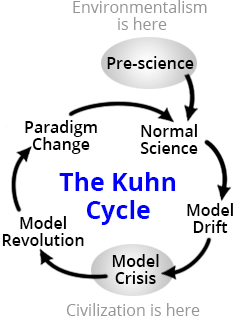 Environmentalism finds itself in the Pre-science step of the Kuhn Cycle. It lacks a valid paradigm for solving its central problem of sustainability. Yet the field's members are assuming they are in the Normal Science step, where a field has a paradigm that works well enough for that field to be called a bona fide science. This is a grave error.
Civilization as a whole is in the Model Crisis step. The model it uses to run itself, mostly free market democracy, a collection of national governments, and some central coordination like the UN and the World Bank, is no longer capable of solving the world's top problems. The model was good enough to navigate through the Industrial Revolution, two world wars, the Great Depression, the Cold War, and other problems. The model shows no sign of being able to solve the global sustainability problem. Because of this void modern environmentalism appeared to fill the gap, beginning with Silent Spring in 1962. But the gap is large and difficult. The new field has so far been unable to provide a new model, a new paradigm, capable of solving the sustainability problem.
The top problem to solve is thus not the sustainability problem itself, but finding the new paradigm needed to solve it. Environmentalism and civilization may not know it but they are both in search of a paradigm that works.
A short introduction to how the Kuhn Cycle works

All new fields begin in Pre-science, where they have begun to focus on a problem area but are not yet capable of solving it or making major advances.
Efforts to provide a model of understanding that works eventually bear fruit. The field can at last make major progress on its central problems. This puts the field in the Normal Science step where it tends to stay longer than any other step.
Over time the field digs so deep into its area of interest it discovers new questions its current model of understanding cannot answer. As more of these anomalies ("violations of expectations") appear the model grows weaker. This is the Model Drift step.
If enough unsolved anomalies appear and the model cannot be patched up to explain them, the Model Crisis step is reached. Here the model is obviously no longer capable of solving the field's current problems of interest. It's a crisis because decisions can no longer be made rationally. Guesswork and intuition must be used instead. These tend to fail.
Finally out of the struggle to form a new model of understanding one or more viable candidates emerge. This begins the Model Revolution step. It's a revolution because the new model is a new paradigm. It's radically different from the old paradigm, so different the two are incommensurate. Each uses its own rules to judge the other. Thus believers in each paradigm cannot communicate well. This causes paradigm change resistance.
Once a single new paradigm is settled on by a few influential supporters, the Paradigm Change step begins. Here the field transitions from the old to the new paradigm while improving the new paradigm to maturity. Eventually the old paradigm is sufficiently replaced and becomes the field's new Normal Science. The cycle then begins all over again, because our knowledge about the world is never complete.
 Previous


