Summary of Analysis Results
Contents
Problem decomposition into the four subproblems
The key analysis simulation model
A high level model of the analysis results
1. Subproblem D - Universally seen as THE problem to solve
2. How Subproblem A controls Subproblem D
3. How Subproblem B controls Subproblem A
4. How subproblem C makes the other subproblem worse
Introduction
Analysis is the breaking down of a problem into smaller easier to solve problems. Exactly how this is done determines the strength of your analysis.
The analysis was performed over a seven year period from 2003 to 2010 while simultaneously developing the System Improvement Process (SIP). Please first read about SIP before attempting to understand the results in the table.
The results are not definitive. They are the work of a single analyst and have not yet been subjected to the rigors of experimentation, calibration, expert opinion review, further iterations, and so on. Thus this is not the analysis or the solution. It's only an example of how a process that fits the problem can be applied. It's an example of what can be done versus what is being done today.
However, the analysis results make plenty of sense. It explains all of the subproblem symptoms. It explains why the environmental movement's present approach has failed. Most important of all, the analysis offers a new way forward that, if the root causes are anywhere close to correct, will work.
Problem decomposition into the four subproblems
To the right is the top of the Summary of Analysis Results. Step 1 is Problem Definition. Next comes decomposition into subproblems. The System Improvement Process decomposes one big problem into the three subproblems present in all difficult social problems:
How to overcome change resistance
How to achieve proper coupling
How to avoid excessive solution model drift
The high level symptoms of the sustainability problem don't make sense and will not yield to analysis unless the problem is further divided into two proper coupling subproblems. This gives us the four subproblems used in the analysis. Here they are along with their symptoms. The symptoms of each subproblem define the problem to solve.
Subproblem A. How to overcome change resistance: We're seeing massive, prolonged successful opposition to passing proposed laws for solving the sustainability problem. This is so huge and such a roadblock that it must be solved first, before any of the other subproblems can be solved.
Subproblem B. How to achieve social proper coupling: As soon as you study the history of the sustainability problem for more than a few days, one outstanding symptom pops out: Large for-profit corporations are dominating political decision making destructively. This includes leading the charge against solving the sustainability problem.
Subproblem C. How to avoid solution model drift: This is a subtle pattern. Nations are not correcting failing solutions when they start failing. Instead, they frequently let solution models drift until solution failure becomes a crisis. Then they laboriously attempt to reactively reform the solution. Solving this subproblem is critical because if enough important problems have their solutions drift too far, a society can be overwhelmed by too many simultaneous problems to solve. This is where most nations and the world are today.
Subproblem D. How to achieve economic proper coupling: The world's economic system is causing unsustainable environmental impact. This is generally seen as The Problem to Solve since it's what produces symptoms like climate change, pollution, soil fertility loss, and dwindling natural resources. However, SIP says that's a trap. In difficult social problems this is never THE problem to solve. The real problem to solve is how to overcome change resistance. Once that is overcome the system will "want" to solve all the other subproblems.
Seeing the sustainability problem through the lens of the four subproblems changes our perspective radically. We are no longer dealing with a complex monster of a problem where everybody who looks at it has a different suggestion on how to solve it. There are thousands of books and articles weighing in on how to solve it. Each expert offers a different solution, which changes to a new one when the old one fails. A steady series of solution fads comes and goes. The world has now gone through five generations of solutions that have all failed.
Why is there such widespread disagreement on how to solve the problem? Because there is no agreement on the root causes. In fact, due to reliance on a process that eschews any notion of root causes, there is no talk at all, or at least to any depth, about root causes. There is only talk about solutions. It's like a bunch of doctors debating how to cure a patient without first performing a diagnosis. If it's a serious illness the patient will die unless those wise and wonderful doctors get very, very lucky.
Let's be a good doctor. Let's examine the system and perform a first iteration analysis of the subproblems. Let's see if we can change the debate to one of first agreeing on the root causes. After that there should be considerably more agreement on solutions because while there can be millions of possible solutions to a difficult problem, there can be only a few practical solutions for resolving a specific root cause.
THE TABLE
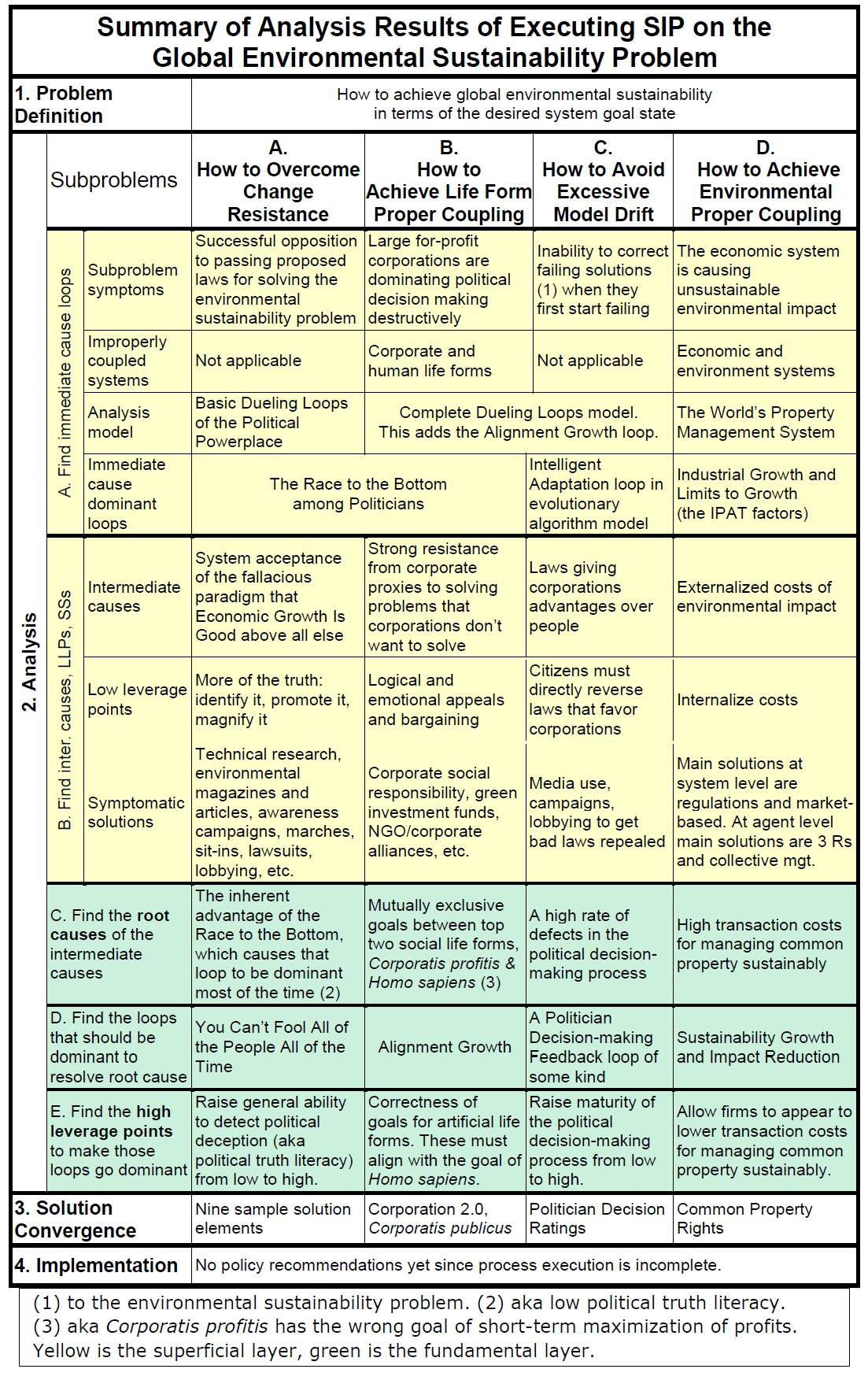
More than anything else on this website, the Summary of Analysis Results Table PDF embodies the heart of Thwink.org's message. The table says:
Solving the sustainability problem requires a highly structured analysis driven by the right problem solving process.
The vast majority of work must be in analysis and not where it is now: trying (in vain) to get solutions adopted by Classic Activism's central strategy of more of the truth.
The one big problem must be decomposed into the right subproblems or it will continue to be insolvable.
There's only one known method of solving each subproblem: root cause analysis.
Examine the three rows in substep B. This is where present work is focused due to lack of a process that fits the problem. Symptomatic solutions, also called superficial solutions, are being used to push on low leverage points to resolve intermediate causes. This absolutely cannot work work because it does not resolve the root causes.
Examine substep C. The analysis hypothesizes these are the main root causes. They are nothing like what environmentalists are focusing on now. They are as different from conventional wisdom as the heliocentric theory that the earth and the planets revolved around the sun was different from the geocentric theory that everything in the sky revolved around the earth. For supporting heliocentrism Galileo was almost burned at the stake. Eventually the theory he championed prevailed because the truth has no higher master.
Key conclusions
These are the essential subproblems. Seeing the sustainability problem this way changes everything. All of a sudden it become obvious why we've been unable to solve the problem. We haven't been trying to overcome systemic change resistance first (subproblem A). Instead, activists of all stripes, from academics to politicians to grassroots activists, have been hammering away on subproblem D: How to achieve economic proper coupling. This is a fatal error. Fortunately it's easily corrected by solving the change resistance subproblem first. After that the system will "want' to solve the sustainability problem. Solutions to the other three subproblems will automatically begin to appear.
For each subproblem, these are the essential root causes. They are highly counterintuitive but once understood explain so much. Many activists sense these are the root causes, so solutions to them are spontaneously appearing, like FactCheck.org (subproblem A) and the campaign to revoke corporate personhood (subproblem B). But because there is no clear knowledge of what the root causes are, there is little agreement on what solutions should be. The result is a smorgasbord of solutions sprawling all over the map and a constant stream of new solutions, new campaigns, that should work but never do.
The key analysis simulation model
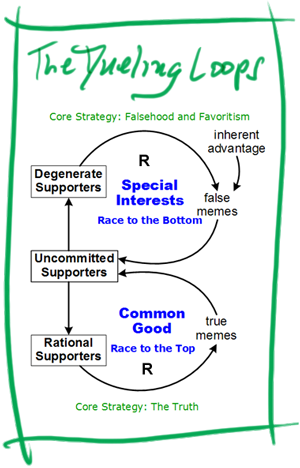
Once the sustainability problem was decomposed into four subproblems, each subproblem was analyzed. The first three subproblems use the same analysis model: The Dueling Loops of the Political Powerplace. Understanding this model is the key to understanding the analysis. The model brings alive the various conclusions listed in the table and reveals the previously invisible structure of the problem.
The Race to the Bottom is the first loop to grasp. Special interests, notably large for-profit corporations and their owners, the rich, are exploiting the system by using the inherent advantage of The Race to the Bottom to win more supporters than those politicians working for the common good. Special interest promoters use false memes to deceive Uncommitted Supporters into becoming Degenerate Supporters.
If you read this easy-to-read paper on The Dueling Loops of the Political Powerplace, your world view will snap into a new one. It will be crystal clear why The Race to the Bottom is winning. If the analysis in the paper is correct, we can now see how we can change the system so that The Race to the Bottom no longer enjoys an inherent advantage. After that The Race to the Top will go dominant. This will rapidly lead to solving problems whose solution would benefit the common good.
A high level model of the analysis results
The whole is indeed greater than the sum of the parts. By analyzing how the four subproblems are interconnected an astounding emergent property becomes visible. We can clearly see why the sustainability problem has been so impossibly difficult to solve. The subproblems work together to create powerful feedback loop forces that if not understood cannot be changed, no matter how hard problem solvers may batter away at the problem.
This section will build a model of how the four subproblems work together. One subproblem at a time will be added. Hopefully this will banish the gloomy fog of complexity hiding the real structure of the problem.
1. Subproblem D - Universally seen as THE problem to solve
Let's begin with what is universally seen as The Problem to Solve: the economic proper coupling subproblem.
In conventional wisdom, the economic system is improperly coupled to the environment. This increases externalized costs, which are the costs of pollution, ecosystem destruction, and natural resource depletion. Externalized costs increase environmental degradation. That's the chief symptoms of the problem, so subproblem D is obviously THE problem to solve.
Conventional wisdom, however, is usually wrong on difficult problems because people are guessing. They can't solve the problem so they are forced to take educated guesses. Sometimes these can work over a long period of time because eventually you guess right.
But in the global environmental sustainability problem, activists have guessed wrong every time. Why? Because they can't see through the fog of problem complexity. Let's begin to lift that fog as we ponder Carl Sandburg's poem of such Haiku like brevity:
Fog
The fog creeps in on little cat feet.
It sit on silent haunches,
Looking over harbor and city,
And then moves on.
2. How Subproblem A controls Subproblem D
The "I can't see it because of the fog" befuddlement begins here. Mainstream environmentalists (including academics, who should be the wisest of all) can see only what's in the circle. That pathological tunnel vision means they cannot see the staggering importance of treating change resistance as a distinct and separate problem to solve first.
Instead, resistance to proposed solutions is treated as a minor thing that can somehow be solved. This is attempted with inspiration, exhortation, and bargaining, which is step four of Classic Activism.
For example, emotionally appealing warm and fuzzy photos of endangered animals are widely used to sell solutions. So are inspirational speeches, articles, and books. And then there's the exhortative cry that we must do this, and must do that because if we don't catastrophe is dead ahead. Pile some aggressive lobbying and campaigning on top of that, and you have the concoction classic activists have been lobbing at the problem for decades.
Superficial solutions like these don't work because they do absolutely nothing to resolve the root cause of subproblem A, which is the crux of the problem. Once change resistance is overcome The Problem to Solve can be solved overnight because the system will now "want" to solve the problem.
Gigantic, prolonged change resistance prevents solution of the The Problem to Solve. The longer the sustainability problem goes unsolved the worse it gets. Subproblem A thus increases subproblem D.
So far the analysis has decomposed the one big problem into two smaller and infinitely easier to solve subproblems because the change resistance subproblem is impossible to solve unless you can clearly see it. The fog is beginning to lift.

3. How Subproblem B controls Subproblem A
Now the 8 million pound gorilla leaps out of the foggy jungle onto the diagram. He's king of the beasts because large for-profit corporations now effectively rule the world. (For discussion see David Korten's When Corporations Rule the World or Thom Hartman's Unequal Protection: The Rise of Corporate Dominance and the Theft of Human Rights.)
Corporations employ most people. They provide most products and services. They control the evolution of new technology. By adapting marketing persuasion techniques to political persuasion, it has become child's play to control elections and politicians so their decisions favor corporations over people.
The outcome is corporate dominance of global society. From the System Improvement Process point of view, two social life forms are improperly coupled: Corporatis profitis and Homo sapiens. If they were properly coupled they would be working together in harmony. Sadly, they are doing just the opposite.
Corporations are leading the charge against solving the sustainability problem. They are THE main source of change resistance. This is well known among sustainability researchers like Sharon Beder, who wrote this in Global Spin: The Corporate Assault On Environmentalism, 2002: (pages 275 and 279)
Surveys show that the majority of people in most countries are not only concerned about the environment, they think environmental protection should be regulated by governments and given priority over economic growth. Yet this widespread public opinion is not translating into government action because of the activities of large corporations that are seeking to subvert or manipulate the popular will.
...the corporate-generated Congressional attack on environmental legislation goes on relentlessly. Industry groups have used their lobbyists, their political contributions, their coalitions and front groups to achieve this result. (p275)
The greater power of corporations [greater than people] in a democratic system has long been recognized. In 1978 an effort to regulate the amount of money that corporations could spend on propaganda was defeated in the US Supreme Court. A dissenting judge wrote:
"Corporations are artificial entities created by law for the purpose of furthering certain economic goals. It has long been recognized, however, that the special status of corporations has placed them in a position to control vast amounts of economic power which may, if not regulated, dominate not only the economy but also the very heart of our democracy, the electoral process."
4. How subproblem C makes the other subproblem worse
Lurking beside the above three subproblems is the solution model drift subproblem. This causes inability to solve the other 3 subproblems. This increases their severity because the longer the go unsolved the worse they get.
Model drift occurs when a solution to a problem drifts away from what's needed to solve the problem, due solution erosion.
Deliberate or accidental solution erosion causes solution model drift. Examples of deliberate solution erosion are exceptions favoring certain special interests, deregulation, and lax regulation. Accidental solution erosion occurs when, due to weakness in the process that produced it, a solution doesn’t keep up with the problem it is solving. The three arrows coming out of subproblem C show how solution erosion increases the severity of the other three subproblems.
Solution model drift has created a crisis for most nations, who are struggling with most of all of these problems:
Environmental sustainability
Sufficient economic growth
Excessive income inequality
Involvement in unnecessary wars
Excessive poverty
Excessive corruption
Over the long term this is the most important subproblem to solve. Once it's solved, future problems like sustainability and corporate dominance will be nipped in the bud when they are still easy to solve. If a large social problem goes unsolved for too long, it can be impossible to solve it before catatrophic symptoms arrive.
5. The feedback loops created by the subproblems
The third main tool for solving the sustainability problem is model based analysis. The structure of social problems can be modeled by identifying the relevant nodes and their relationships, as represented by arrows of influence. Applying this tool reveals three powerful feedback loops.
Big for-profit corporations shun paying more to save the environment. That increases externalized costs, which increases profits, which in turn increases corporate dominance all the more. The Corporate Dominance Growth Due to More Externalized Costs loop is a reinforcing loop, so it grows and grows. Over time this causes extreme amounts of corporate dominance.
For example, the Great Recession of 2008 was a case of corporate dominance run amok. Rabid encouragement of consumer, corporate, and investor debt, the watering down of various banking industry regulations, lax regulation, and the pervasive myth of "growth is all that matters" drove the Western world into the biggest bubble since the Great Depression. It was thanks to the Corporate Dominance Growth Due to Solution Erosion that all that watering down and lax regulation occurred.
All bubbles eventually pop. This one popped so badly that in late 2008 US voters voted out the party that caused the problem by a landslide. But a mere two years later, due the power of the Corporate Dominance Growth Due to Successful Mass Deception loop, US voters reversed course and voted the party that had caused the Great Recession right back into office. Amazing! But easily explained by the loop. Change resistance to solving a problem that would increase the common good cannot be based on factual argument. It can only be based on deception, so that voters will vote against their own best interests and for those of special interests, the most special of which is the new dominant life form, also known as the modern large for-profit corporation and their allies, notably the rich. Mass deception is what Sharon Beder's Global Spin: The Corporate Assault On Environmentalism was all about.
The model has grown to the point where it can offer profound explanations of problem behavior. The fog obscuring the problem has almost totally lifted. Our adventuresome hike into the clouds, the mists of the problem, is almost over.

6. The root causes and high leverage points
The root cause and high leverage point for each subproblem are shown. Our model is complete.
Remember that all the environmental movement sees is what's in the circle. The rest is lost in the fog of problem complexity and reliance on a process that doesn't fit the problem. Classic activists can't see subproblems B, A, and C, so they can't see the three powerful feedback loops making the problem worse and even harder to solve. Since there's no concept of root causes, those are invisible too. All this has made the problem impossible to solve.
But there is an alternative. Once the right tools reveal the true nature of a problem, all difficult problems become solvable. The rest were fantasies that were never possible.
At the center of the model lies the crux of the problem. The root cause of successful change resistance is high political deception effectiveness. This allows mass deception of voters and politicians. The high leverage point for resolving the root cause is obvious. It's to raise general ability to detect political deception. In other words, we have to bring truth literacy to the masses. Once they have drunk from that cup there will be no turning back, just as there was no turning back when reading and writing literacy began to spread from the elite few to the masses at the dawn of the Industrial Revolution, which reduced the price of paper and books so they were afforadable by all classes of society.
The three Corporate Dominance Growth loops are pumping away every day, making corporations all the more more dominant. The strength of a feedback loop is a social system force. The corporate life form thus has three prodigious forces that make controlling the human system and staying in power as easy as the way kings dominated the world before democracy was invented. If you're in power and you have the right loops increasing your power all the more, or at least maintaining it, how can anyone boot you out?
It's enough to make an environmentalist weep.
How can we possibly solve the problem?
It would seem we can't, due to the terrific forces generated by the structure of the problem. But an analysis like this has never been performed before. Environmentalists have never had their own prodigious advantage. Now they do.
Because the fog has lifted the structure of the problem is revealed in full. There are the four subproblems, their feedback loops, and most importantly, their root causes and high leverage points. The keys to the castle are sitting right there. No longer do we have to use crude and naive battering rams to force out way into the castle and solve the problem. We can simply take advantage of our new analytical knowledge, pick up those keys, and develop solution elements for pushing on the high leverage points. We can engineer (and not guess at) solutions that stand a very good chance of opening the castle door at last. If all goes well we can vanquish that 8 million pound gorilla, boot him out of the castle, and put The People back in control of the human system.
It's enough to make an environmentalist jump for joy!

Analysis of each subproblem
Click on an image below for a summary of analysis of that subproblem. For a very small summary see the Analysis dropdown menu.
The full analysis
For this see the Common Property Rights: A Process Driven Approach to Solving the Complete Sustainability Problem book.
1. Part One presents the most ready-to-implement solution element with the lowest amount of anticipated change resistance: Common Property Rights.
2. Part Two reviews the three main problem solving processes currently used, explains their drawbacks, and then presents an alternative that could work: the System Improvement Process.
3. Part Three presents the analysis and solution elements. This is the bulk of the book.
The first and second photos were taken in 2002 while hiking in central France. The third photo was on a short Sierra Club hike led by Gordon Draves in 2011. After slogging through high weeds full of ticks and jungles of woods, we broke into a clearing and were dazzled by the big sky beauty of it all. One of us expressed his joy.

Subproblem A. How to overcome change resistance: We're seeing massive, prolonged successful opposition to passing proposed laws for solving the sustainability problem. This is so huge and such a roadblock that it must be solved first, before any of the other subproblems can be solved.
Subproblem B. How to achieve social proper coupling: As soon as you study the history of the sustainability problem for more than a few days, one outstanding symptom pops out: Large for-profit corporations are dominating political decision making destructively. This includes leading the charge against solving the sustainability problem.
Subproblem C. How to avoid solution model drift: This is a subtle pattern. Nations are not correcting failing solutions when they start failing. Instead, they frequently let solution models drift until solution failure becomes a crisis. Then they laboriously attempt to reactively reform the solution. Solving this subproblem is critical because if enough important problems have their solutions drift too far, a society can be overwhelmed by too many simultaneous problems to solve. This is where most nations and the world are today.
Subproblem D. How to achieve economic proper coupling: The world's economic system is causing unsustainable environmental impact. This is generally seen as The Problem to Solve since it's what produces symptoms like climate change, pollution, soil fertility loss, and dwindling natural resources. However, SIP says that's a trap. In difficult social problems this is never THE problem to solve. The real problem to solve is how to overcome change resistance. Once that is overcome the system will "want" to solve all the other subproblems.


