
The Dueling Loops of the Political Powerplace
The Full Paper PDF
For your convenience this web page contains the first four pages of the paper. For the full paper please click the above link.
This is the May 2012 second edition of the December 2005 paper that crystallized the key insights in the work at Thwink. It was a breakthrough. More people have gotten excited and contacted us due to reading this paper or the videos than anything else on the site.
This is not a formal academic paper. It was never intended to be published in a peer reviewed journal. Instead, it was written in paper form due to the serious, technical nature of the material. It's jargon free and relatively easy to read, because it wasn't written for academics. It was written for serious activists like you.
If you have doubts about the ability of simulation modeling to solve serious social problems, read this story about How the Urban Decay Crisis Was Solved.
If you like the paper, try the Dueling Loops Video Series or the Dueling Loops book.
Contents
The fundamental message of the paper
The first four pages of the paper
The fundamental message of the paper
The Dueling Loops paper PDF uses a surprisingly simple simulation model to explain the fundamental behavior of all political systems, such as:
1. WHY does democracy work in theory to optimize the common good (the vast majority), but in practice maximizes benefits to special interests (small minorities) like the rich and corporations?
2. WHY is there so much change resistance to passing laws that would solve common good problems like environmental unsustainability, excessive income inequality, and corruption?
3. WHY do political parties tend to evolve into two main parties or types of parties, with one speaking for The People and the other for special interests? In other words, why doe the left/right political spectrum appear in all democracies?
The answers are all here.
The answers lie in the fundamental structure present in all political systems. This structure consists of two opposing feedback loops. These loops are locked in a perpetual duel to see which loop can win the most supporters. From this perpetual duel arises the name of the structure: The Dueling Loops of the Political Powerplace. This structure explains so much that it is as fundamental to political science as the evolutionary algorithm is to the life sciences or the basic structure of molecules is to chemistry.
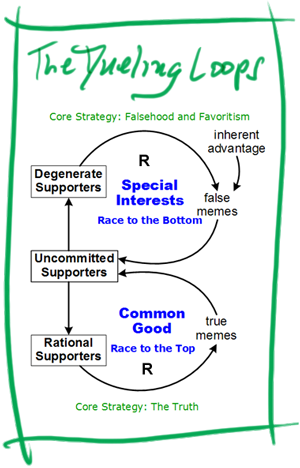 The key to grasping the power of the Dueling Loops is to see that the Race to the Bottom has an inherent advantage over the Race to the Top. This advantage explains why special interests are usually winning and the interests of the majority of The People are losing. This advantage answers the three WHY questions posed above and many more.
If you are a public interest activist, then you are trying to help solve problems whose solution would benefit the common good. You are thus one of the Rational Supporters in the Dueling Loops model. You are essentially using true memes to promote your position and solutions. If this works some Uncommitted Supporters will become Rational Supporters. If enough of this occurs the Race to the Top will become the dominant loop on the issues you are promoting. That's how Classic Activism is supposed to work.
But classic activists are unaware of the Dueling Loops. They can't see the Race to the Bottom contains an inherent advantage: the size of false memes (also called lies or deception) can be inflated but the size of true memes can not. An honest rational politician cannot inflate the size of the truth. But a dishonest degenerate politician can. He can make all sorts of false promises like "Balancing the budget is easy. All it takes is cutting taxes to stimulate growth." Or he can make false claims about his opponent, using negative campaign ads that are no more that fallacious ad hominem attacks. The Dueling Loops paper explains all this by describing the five main types of political deception used by degenerate politicians to exploit the inherent advantage of the Race to the Bottom.
If you are an activist, scholar, politician, manager, or citizen who is tying to promote the common good, then this paper is for you.
The first four pages of the paper
Preface to the Second Edition
It’s been seven years since the first edition of this paper in 2005. The second edition changes little. But what it changes makes all the difference.
This edition clarifies the all-important fact that the Dueling Loops model is generic. It explains far more than what the first edition focused on: the world’s inability to solve the environmental sustainability problem. The second edition emphasizes why society is unable to solve any important problem whose solution would benefit the common good, like environmental sustainability, excessive income inequality, avoidable recessions, unnecessary wars, and corruption.
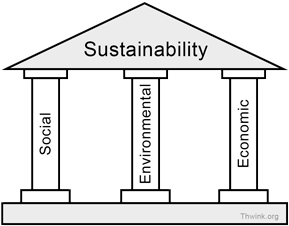
This paper addresses the complete sustainability problem. The long term sustainability of any society rests on three main pillars: social, environmental, and economic. All three pillars must be strong and sustain-able for a society to be sustainable. Thus when this paper says “sustainable” it means far more than the popular definition of the word, which is only environmental sustainability. In this paper sustainable refers to all three pillars, which is complete sustainability.
Abstract
Most effort on solving the sustainability problem focuses on its technical side: the proper practices that must be followed to be sustainable. But surprisingly little effort addresses why most of society is so strenuously resisting adopting those practices, which is the change resistance side.
 This paper presents a root cause analysis of the change resistance part of the problem using a simulation model. The model shows the main source of change resistance lies in a fundamental structure called The Dueling Loops of the Political Powerplace. This consists of a race to the bottom among politicians battling against a race to the top. Due to the inherent (and well hidden) advantage of the race to the bottom it is the dominant loop most of the time, as it is now. As long as it remains dominant, resistance to solving sustainability problems will remain so high they are insolvable.
The analysis has, however, uncovered a tantalizing nugget of good news. There is a promising high leverage point in this structure that has never been tried. If problem solvers could unite and push there with the proper solutions, it appears the change resistance side of the problem would be solved in short order and the Sustainability Revolution would begin.
Why Overcoming Change Resistance Is the Crux of the Problem
The transformation of society to sustainability requires three steps: The first is the profound realization we must make the change, because if we don’t our descendants are doomed. The second is finding the proper practices that will allow living sustainably. The third step is adopting those practices.
Society has faltered on the third step. By now the world is aware it must live sustainably, which is the first step. There are countless practical, proven ways to do this, which is the technical side of the problem and the second step. But for strange and mysterious reasons society doesn’t want to take the final step and adopt these practices, which is the change resistance side of the problem. Therefore overcoming change resistance is the crux of the problem.
Let’s first examine the environmental pillar. Here’s what the 2004 third edition of Limits to Growth had to say about the change resistance side of the problem:
[The second edition of Limits to Growth] was published in 1992, the year of the global summit on environment and development in Rio de Janeiro. The advent of the summit seemed to prove that global society had decided to deal seriously with the important environmental problems. But we now know that humanity failed to achieve the goals of Rio. The Rio plus 10 conference in Johannesburg in 2002 produced even less; it was almost paralyzed by a variety of ideological and economic disputes, [due to] the efforts of those pursuing their narrow national, corporate, or individual self-interests.
…humanity has largely squandered the past 30 years…
What about all three pillars of sustainability? For that let’s turn to a recent study of the US political system by Thomas Mann and Norman Ornstein:
We have been studying Washington politics and Congress for more than 40 years, and never have we seen them this dysfunctional. In our past writings, we have criticized both parties when we believed it was warranted. Today, however, we have no choice but to acknowledge that the core of the problem lies with the Republican Party.
The GOP has become an insurgent outlier in American politics. It is ideologically extreme; scornful of compromise; unmoved by conventional understanding of facts, evidence and science; and dismissive of the legitimacy of its political opposition.
When one party moves this far from the mainstream, it makes it nearly impossible for the political system to deal constructively with the country’s challenges.
The US Republican party is causing high change resistance to solving pressing problems that need to be solved today. This pattern is typical across all industrialized nations. None have been able to give their top problems, those dealing with social, environmental, and economic sustainability, the full attention they deserve. That’s why so many common good problems go unsolved. It’s why the world is in such a perilous mess.
What is the underlying cause of such stiff change resistance? Whatever it is, it must be incredibly strong to cause such a powerful effect.
We might begin to find that elusive cause if we drilled down and tried to determine why change resistance occurs at the level of nations. For example, looking at the world’s sole remaining superpower, why did the US Senate vote 95 to zero in 1999 to reject the Kyoto Protocol, despite a democratic President and a strongly pro-environmental Vice President, Al Gore? Why, since the ascendancy of the George W. Bush administration in the United States in 2001, has opposition grown to the point that progress in solving the environmental sustainability problem, the rising income inequality problem, and other common good problems is moving backwards? Why do US environmental NGOs face “the most hostile environment in which we have ever struggled to advance our goals,” as the Union of Concerned Scientists describes it?
If we could find the root causes of why the political system works the way it does, we could answer these questions and go further than we’ve ever gone before. We could find the high leverage points in the system that would allow changing that “hostile environment” into one that actively welcomed solving the problem, and thus solve the change resistance problem.
This paper attempts to do this by performing a root cause analysis using a simulation model. Because the structure of the model so clearly exposes the root causes of change resistance, the high leverage point where problem solvers should “push” to solve the problem becomes conspicuously obvious. Six solution elements are then presented to illustrate how feasible pushing on this point could be.
The Race to the Bottom
There are two feedback loops in the human system that, in the large, affect citizen’s lives more than anything else. They are the loops that politicians use to gain supporters.
Over time, social evolution has pared the many strategies available for gaining political support into just two main types: the use of truth (virtue) and the use of falsehood and favoritism (corruption). For example, a virtuous politician may gain supporters by stating, “I know we can’t balance the budget any time soon, but I will form a panel of experts to determine what the best we can do is.” Meanwhile, a corrupt politician is garnering supporters by saying, “Economics is easy. You just put a firm hand on the tiller and go where you want to go. I can balance the budget in four years, despite what the experts are saying. They are just pundits. Don’t listen to them. A vote for me is a vote for a better future.” The corrupt politician is also saying to numerous special interest groups, “Yes, I can do that for you. No problem.” Guess who will usually win?
Falsehood and favoritism has long dominated political strategy. Most politicians use rhetoric, half truths, glittering generalities, the sin of omission, biased framing, and other types of deception to appeal to the greatest number of people possible for election or reelection. Once in office nearly all politicians engage in acts of favoritism, also known as patronage.
For example most politicians use the ad hominem (Latin for against the man) fallacy to attack and demonize their opponents, particularly as an election draws near. A prominent recent instance was the use of the Swift boat ads in the 2004 US presidential campaign to attack John Kerry’s character. The ads were an ad hominem fallacy, because they had nothing to do with Kerry’s political reasoning or positions. Other terms for the ad hominem fallacy are demagoguery, shooting the messenger, negative campaigning, smear tactics, and sliming your opponent.
Politicians are forced to use corruption to gain supporters, because if they do not they will lose out to those who do. This causes the Race to the Bottom among Politicians to appear, as shown below.

Figure 1. The loop grows in strength by using corruption in the form of highly appealing falsehood and favoritism. This increases the number of supporters of corrupt politicians, which increases their influence, which in turn increases their power to peddle still more falsehood and favoritism. Over time the loop can grow to tragically high levels.
To understand how the loop works, let’s start at false memes. A meme is a mental belief that is transmitted (replicated) from one mind to another. Memes are a very useful abstraction for understanding human behavior because memes replicate, mutate, and follow the law of survival of the fittest, just as genes do. Rather than show falsehood and favoritism, the model is simplified. It shows only falsehood.
The more false memes transmitted, the greater the degenerates infectivity rate. The model treats arrival of a meme the same way the body treats the arrival of a virus: it causes infection. After the “mind virus" incubates for a period of time, the infection becomes so strong that maturation occurs. This increases the degenerates maturation rate, which causes supporters to move from the pool of Not Infected Neutralists to the pool of Supporters Due to Degeneration as they become committed to the false memes they are now infected with. Supporters Due to Degeneration times influence per degenerate equals degenerates influence. The more influence a degenerate politician has, the more false memes they can transmit, and the loop starts over again. As it goes around and around, each node increases in quantity, often to astonishing levels. The loop stops growing when most supporters are committed.
The dynamic behavior of the loop is shown in Figure 2. The behavior is quite simple because the model has only a single main loop.

Figure 2. The simulation run starts with 1 degenerate and 99 neutralists. Over time the percentage of degenerates grows to 75% and stops. What keeps it from growing to 100% is the way degenerates can recover from their infection, after a degenerates infection lifetime of 20 years.
Corrupt politicians exploit the power of the race to the bottom by broadcasting as much falsehood and favoritism as possible to potential supporters. This is done with speeches, interviews, articles, books, jobs, lucrative contracts, special considerations in legislation, etc. The lies and favors are a cunning blend of whatever it takes to gain supporters. The end justifies the means. Note that the more influence a politician has, the more falsehood they can afford to broadcast, and the greater the amount of favoritism they can plausibly promise and deliver.
The race to the bottom is the loop driving politics to extremes of falsehood and favoritism in far too many areas of the world. This loop is the structural cause behind most of the corruption and bad decisions in government today.
Deception is the act of propagating a belief that is false. The race to the bottom employs a dazzling array of deception strategies. These are usually combined to increase their power. The five main types of deception strategies are:
1. False promise
2. False enemy
3. Pushing the fear hot button
4. Wrong priority
5. Secrecy
Deception Type 1: False promise
A false promise is a promise that is made but never delivered, or never delivered fully. False promises are widely used to win the support of segments of the population, such as organized special interest groups, industries, and demographic groups like seniors or immigrants. False promises flow like wine during election season. The next time you see this happening, think of it as proof the race to the bottom exists, and as proof that few politicians can escape the pressure to join the race to the bottom.
One of the largest false promises in recent history was the way Russian communism promised one thing but delivered another. It promised rule by the masses for the masses but delivered a totalitarian state. To justify its continued existence and hide the broken promise, the communist system manufactured a steady stream of soothing lies and used harsh repressive techniques on those who did not swallow the lies.
Near the end of the collapse of Russian communism, Václav Havel, writing in 1978 in Versuch, in der Wahrheit zu leben (An Attempt to Live in Truth) pointed out the diabolical, self-destructive nature of the communist approach. It was the ultimate vicious cycle because:
…it turned victims into accomplices: by threatening them and their descendents with disadvantages, it coerces the victims to participate. When Havel became President [of Czechoslovakia in 1989] he reminded his fellow citizens of their complicity arising from their coming to terms with life in lying. Consequently, he exhorted them… to vote for candidates who ‘are used to telling the truth and do not wear a different shirt every week’.
Civilization has a learning problem. It does not seem to learn from its mistakes, even when they are pointed out. It has not learned the lesson that false promises work so well to destroy lives en masse that their effectiveness must be eliminated somehow. This is nothing new, however. We have been warned before. For example, long ago in the 14th century Machiavelli explained why false promises are so rampant in The Prince, in the chapter on “How Princes Should Honor Their Word:”
Everyone knows how praiseworthy it is for a prince to honor his word and to be straightforward rather than crafty in his dealings; nonetheless contemporary experience shows that princes who have achieved great things have been those who have given their word lightly, who have known how to trick men with their cunning, and who, in the end, have overcome those abiding by honest principles. …it follows that a prudent ruler cannot, and must not, honor his word when it places him at a disadvantage and when the reasons for which he made his promise no longer exist. … Everyone sees what you appear to be, few experience what you really are.
Above are the first four pages of The Dueling Loops PDF paper. The rest is better read by reading the PDF file, which gives you the option of printing it out for serious contemplation.
The simulation models
The paper bases its analysis on four thoughtfully constructed simulation models. The main portion of the third one is shown below. It says so much. Note the well named feedback loops and the low and high leverage points.

Before downloading the models please see The World of Simulation for how to run them. You will need to install special free software. There has been some discussion of the dueling loops on the forum in this thread.
Here are the Vensim stock and flow simulation models ZIP described in the paper.
What people are saying
Here is a blog review of the paper from 2007.
The Dueling Loop paper provoked so much interest that a series of videos based on the paper was created. The videos visually explain how the Dueling Loops model works, from a variety of angles.
The videos went on to become more popular than the paper for awhile. But for the essence of the concept, people continue to return to read the paper. Some can cite its message from memory, even years later. For example, on March 1, 2012 this message appeared on The Oil Drum: (bolding added)
DrNick
Interesting research... It actually reminds me of a paper I read a few years back on "Dueling Loops", which uses a system dynamics model to explain why politics is a "race to the bottom" rather than a "race to the top". See: [link to this page]
The paper also offers an explanation for why the usual "solution" to the problem (try to inform/educate the electorate) doesn't work. The bad guys always have more power, money and airtime to *mis*-inform.
What *might* work (but has never actually been tried) is to improve the general ability of the population to discriminate between good and bad arguments: effectively to teach techniques for sniffing out propaganda and rhetoric. We don't actually need to provide factual knowledge, just train in the ability to decide who else really has it (and who is bluffing).
This ability doesn't require any technical skills, or superior intelligence, and it seems it can be learned by anyone of average intelligence (so the bulk of voters). But it does take time to learn. In that sense, it's a lot like literacy or basic numeracy. Also most intelligent or technically skilled people don't have this ability, because they've never learned it, which is why they are so awful outside their domain of expertise. I recall Aldous Huxley made a similar general point about propaganda analysis in "Brave New World Revisited".
On March 23, 2012 this comment appeared in a long thread on Systems Thinking World. In it TA talks of the Dueling Loops videos rather than the paper: (bolding added)
T.A. Balasubramanian • Norman
You rightly observed, "Global sustainability is still the most forbidden and dangerous subject on the planet because too many people are trapped in political, social and religious boxes."
Forbidden and dangerous, no doubt, but not beyond the domain of applied systems thinking, if one really gets down to analyzing and observing the systems here! Here's a beautifully articulated fundamental systems thinking approach to the solution. It's called 'Root Cause Analysis' - and it drills down to the cycles of political power that control and dominate the sustainability dialogue - often unnoticed and invisible.
In two latter posts TA had this to say:
T.A. Balasubramanian • Helene
The ST model of Dueling Loops was in response to Norman's post. It drills down to the fundamental problem of why decades of sustainability proposals - Rio 1, Davos and so on - keep getting stuck.
It explains why there's such strong resistance to solving the sustainability problem and other problems whose solution would benefit the common good. The model shows the low leverage point that problem solvers are presently pushing on and why that doesn't work. It also shows the high leverage points they must push on instead and why that is much more likely to solve the systemic change resistance part of the problem.
Of course one can ignore it and continue with the next Rio and the next for several more decades - but its worth noticing - like Norman correctly points out - that the progress in sustainability projects is blocked, not in the lack of UN initiatives, but elsewhere in the inefficiencies of the flawed political-economic systems that are expected to support those who implement the projects and proposals.
T.A. Balasubramanian • David
Whether you agree or not, the premises of the Dueling Loops model are based on the current realities of political events - particular to the US Bush era, maybe, but the model, in my view, applies equally to other political systems - such as in India - where corruption has been the central theme of Anna Hazare's people's movement for over a year now.
Systems dynamics modeling and simulation is very much a part of ST. I don't know why you see them as distinct.
For example, Barry Richmond discusses in his paper "Systems thinking: critical thinking skills for the 1990s and beyond" seven systems thinking skills:
- dynamic thinking: seeing patterns, not only events
- closed-loop thinking: interrelated processes instead of of one-way relations;
- generic thinking: seeing generic structures beyond specific symptoms;
- structural thinking: thinking in stock and flow structures;
- operational thinking: "a milk production systems should include cows";
- continuum thinking: finding ways between the "black and white" extremes;
- scientific thinking: making things quantify-able and testable.
The Dueling Loops model applies most of the above in different ways.
Discussion continued on the thread on a variety of topics, including the Dueling Loops.
On August 1, 2012 this editorial appeared in PoliticsWeb, "a website focused on the news and politics of Southern Africa." Below are the first four paragraphs:
Zimbabwe and the race to the bottom
By Vince Musewe | 01 August 2012
Vince Musewe says all too often Africa's politicians have been able to master the art of deception
I have stumbled upon what I think are some fascinating thoughts on politics and sustainable social change in Jack Harich's paper titled: "The Dueling Loops of the Political Powerplace". Jack, is a consultant and systems engineer in Atlanta, Georgia, US and his ideas are published on thwink.org. I would suggest that my patient readers read it, as we move towards important leadership elections in both Zimbabwe and South Africa. The season of political electioneering will be upon us soon as we continue to grapple on how best to establish progressive social systems. It is therefore important that we really begin to reflect on the type of leadership now required to take Africa to the next level.
In this paper, Harich emphasizes why society is unable to solve any important problem whose solution would benefit the common good such as: environmental sustainability, excessive income inequality, avoidable recessions, unnecessary wars, corruption among others.
I have contemplated a thousand times on why Africa remains locked in poverty and inequality despite the prodigious resource base which we possess. Perhaps it is only now, that I am beginning to have inkling on how we may be able to cause positive change.
Harich's paper has helped me tremendously in applying my mind on these issues. I anticipate that it may also do that for you. We must become constructive citizens in confronting resistance to positive social change that we all desire and this, requires a deeper understanding of politics and the motives, behaviors and idiosyncrasies of those that practice it.
Vince Musewe continues to apply the concepts in the Dueling Loops paper, such as this guest columnist article on December 10, 2015.
-

-
Analysis is the breaking down of a problem into smaller easier to solve problems. Exactly how this is done determines the strength of your analysis.
You will see powerful techniques used in this analysis that are missing from what mainstream environmentalism has tried. This explains why a different outcome can be expected.
The key techniques are proper subproblem decomposition and root cause analysis.
The analysis was performed over a seven year period from 2003 to 2010. The results are summarized in the Summary of Analysis Results, the top of which is shown below:
Click on the table for the full table and a high level discussion of analysis results.
This is the solution causal chain present in all problems. Popular approaches to solving the sustainability problem see only what's obvious: the black arrows. This leads to using superficial solutions to push on low leverage points to resolve intermediate causes.
Popular solutions are superficial because they fail to see into the fundamental layer, where the complete causal chain runs to root causes. It's an easy trap to fall into because it intuitively seems that popular solutions like renewable energy and strong regulations should solve the sustainability problem. But they can't, because they don't resolve the root causes.
In the analytical approach, root cause analysis penetrates the fundamental layer to find the well hidden red arrow. Further analysis finds the blue arrow. Fundamental solution elements are then developed to create the green arrow which solves the problem. For more see Causal Chain in the glossary.
First the analysis divided the sustainability problem into four subproblems. Then each subproblem was individually analyzed. For an overview see The Four Subproblems of the Sustainability Problem.
This is no different from what the ancient Romans did. It’s a strategy of divide and conquer. Subproblems like these are several orders of magnitude easier to solve because you are no longer trying (in vain) to solve them simultaneously without realizing it. This strategy has changed millions of other problems from insolvable to solvable, so it should work here too.
For example, multiplying 222 times 222 in your head is for most of us impossible. But doing it on paper, decomposing the problem into nine cases of 2 times 2 and then adding up the results, changes the problem from insolvable to solvable.
Change resistance is the tendency for a system to resist change even when a surprisingly large amount of force is applied.
Overcoming change resistance is the crux of the problem, because if the system is resisting change then none of the other subproblems are solvable. Therefore this subproblem must be solved first. Until it is solved, effort to solve the other three subproblems is largely wasted effort.
The root cause of successful change resistance appears to be effective deception in the political powerplace. Too many voters and politicians are being deceived into thinking sustainability is a low priority and need not be solved now.
The high leverage point for resolving the root cause is to raise general ability to detect political deception. We need to inoculate people against deceptive false memes because once people are infected by falsehoods, it’s very hard to change their minds to see the truth.
Life form improper coupling occurs when two social life forms are not working together in harmony.
In the sustainability problem, large for-profit corporations are not cooperating smoothly with people. Instead, too many corporations are dominating political decision making to their own advantage, as shown by their strenuous opposition to solving the environmental sustainability problem.
The root cause appears to be mutually exclusive goals. The goal of the corporate life form is maximization of profits, while the goal of the human life form is optimization of quality of life, for those living and their descendents. These two goals cannot be both achieved in the same system. One side will win and the other side will lose. Guess which side is losing?
The high leverage point for resolving the root cause follows easily. If the root cause is corporations have the wrong goal, then the high leverage point is to reengineer the modern corporation to have the right goal.
Solution model drift occurs when a problem evolves and its solution model doesn’t keep up. The model “drifts” away from what’s needed to keep the problem solved.
The world’s solution model for solving important problems like sustainability, recurring wars, recurring recessions, excessive economic inequality, and institutional poverty has drifted so far it’s unable to solve the problem.
The root cause appears to be low quality of governmental political decisions. Various steps in the decision making process are not working properly, resulting in inability to proactively solve many difficult problems.
This indicates low decision making process maturity. The high leverage point for resolving the root cause is to raise the maturity of the political decision making process.
In the environmental proper coupling subproblem the world’s economic system is improperly coupled to the environment. Environmental impact from economic system growth has exceeded the capacity of the environment to recycle that impact.
This subproblem is what the world sees as the problem to solve. The analysis shows that to be a false assumption, however. The change resistance subproblem must be solved first.
The root cause appears to be high transaction costs for managing common property (like the air we breath). This means that presently there is no way to manage common property efficiently enough to do it sustainably.
The high leverage point for resolving the root cause is to allow new types of social agents (such as new types of corporations) to appear, in order to radically lower transaction costs.
-
There must be a reason popular solutions are not working.
Given the principle that all causal problems arise from their root causes, the reason popular solutions are not working (after over 40 years of millions of people trying) is popular solutions do not resolve root causes.
This is Thwink.org’s most fundamental insight.
Using the results of the analysis as input, 12 solutions elements were developed. Each resolves a specific root cause and thus solves one of the four subproblems, as shown below:
Click on the table for a high level discussion of the solution elements and to learn how you can hit the bullseye.
The solutions you are about to see differ radically from popular solutions, because each resolves a specific root cause for a single subproblem. The right subproblems were found earlier in the analysis step, which decomposed the one big Gordian Knot of a problem into The Four Subproblems of the Sustainability Problem.
Everything changes with a root cause resolution approach. You are no longer firing away at a target you can’t see. Once the analysis builds a model of the problem and finds the root causes and their high leverage points, solutions are developed to push on the leverage points.
Because each solution is aimed at resolving a specific known root cause, you can't miss. You hit the bullseye every time. It's like shooting at a target ten feet away. The bullseye is the root cause. That's why Root Cause Analysis is so fantastically powerful.
The high leverage point for overcoming change resistance is to raise general ability to detect political deception. We have to somehow make people truth literate so they can’t be fooled so easily by deceptive politicians.
This will not be easy. Overcoming change resistance is the crux of the problem and must be solved first, so it takes nine solution elements to solve this subproblem. The first is the key to it all.
In this subproblem the analysis found that two social life forms, large for-profit corporations and people, have conflicting goals. The high leverage point is correctness of goals for artificial life forms. Since the one causing the problem right now is Corporatis profitis, this means we have to reengineer the modern corporation to have the right goal.
Corporations were never designed in a comprehensive manner to serve the people. They evolved. What we have today can be called Corporation 1.0. It serves itself. What we need instead is Corporation 2.0. This life form is designed to serve people rather than itself. Its new role will be that of a trusted servant whose goal is providing the goods and services needed to optimize quality of life for people in a sustainable manner.
Solution element: Corporation 2.0
What’s drifted too far is the decision making model that governments use to decide what to do. It’s incapable of solving the sustainability problem.
The high leverage point is to greatly improve the maturity of the political decision making process. Like Corporation 1.0, the process was never designed. It evolved. It’s thus not quite what we want.
The solution works like this: Imagine what it would be like if politicians were rated on the quality of their decisions. They would start competing to see who could improve quality of life and the common good the most. That would lead to the most pleasant Race to the Top the world has ever seen.
Solution element: Politician Decision Ratings
Presently the world’s economic system is improperly coupled to the environment. The high leverage point is allow new types of social agents to appear to radically reduce the cost of managing the sustainability problem.
This can be done with non-profit stewardship corporations. Each steward would have the goal of sustainably managing some portion of the sustainability problem. Like the way corporations charge prices for their goods and services, stewards would charge fees for ecosystem service use. The income goes to solving the problem.
Corporations gave us the Industrial Revolution. That revolution is incomplete until stewards give us the Sustainability Revolution.
Solution element: Common Property Rights
-
This presents our research results, including SIP, analysis of the environmental sustainability problem, and twelve sample solution elements.
This analyzes the world’s standard political system and explains why it’s operating for the benefit of special interests instead of the common good. Several sample solutions are presented to help get you thwinking.
-
The Democracy in Crisis Film Series
Introduction to the WorldChange Model, 27 min
Adding Change Resistance to IGMs, 29 min
Part 1. Introduction to Common Property Rights, 15 min
Part 2. The 7 Components of Common Property Rights, 23 min
Truth or Deception, 10 min
The Progressive Paradox Film, 123 min
Introduction to Analytical Activism, 48 min
-
One way to get started is The Common Property Rights Project.
This can be done by switching to Root Cause Analysis, which will lead to Environmentalism 2.0.


