
How You Can Help
The goal of Thwink.org is to help solve the complete sustainability problem using the most efficient and effective methods of analysis available.
That is not an easy goal. In fact, it's proven very difficult so far. The pattern is the Thwink.org paradigm is so far from conventional wisdom that very few people have taken up the Thwink approach. This is the phenomenon of new paradigm change resistance. Paradigm change is unfortunately usually slow.
If you would like to help us overcome that change resistance, here's a few ways you can help:
1. Put these ideas to use! The website is primarily an educational reference site. It's loaded with ideas that may help you better achieve your own goals.
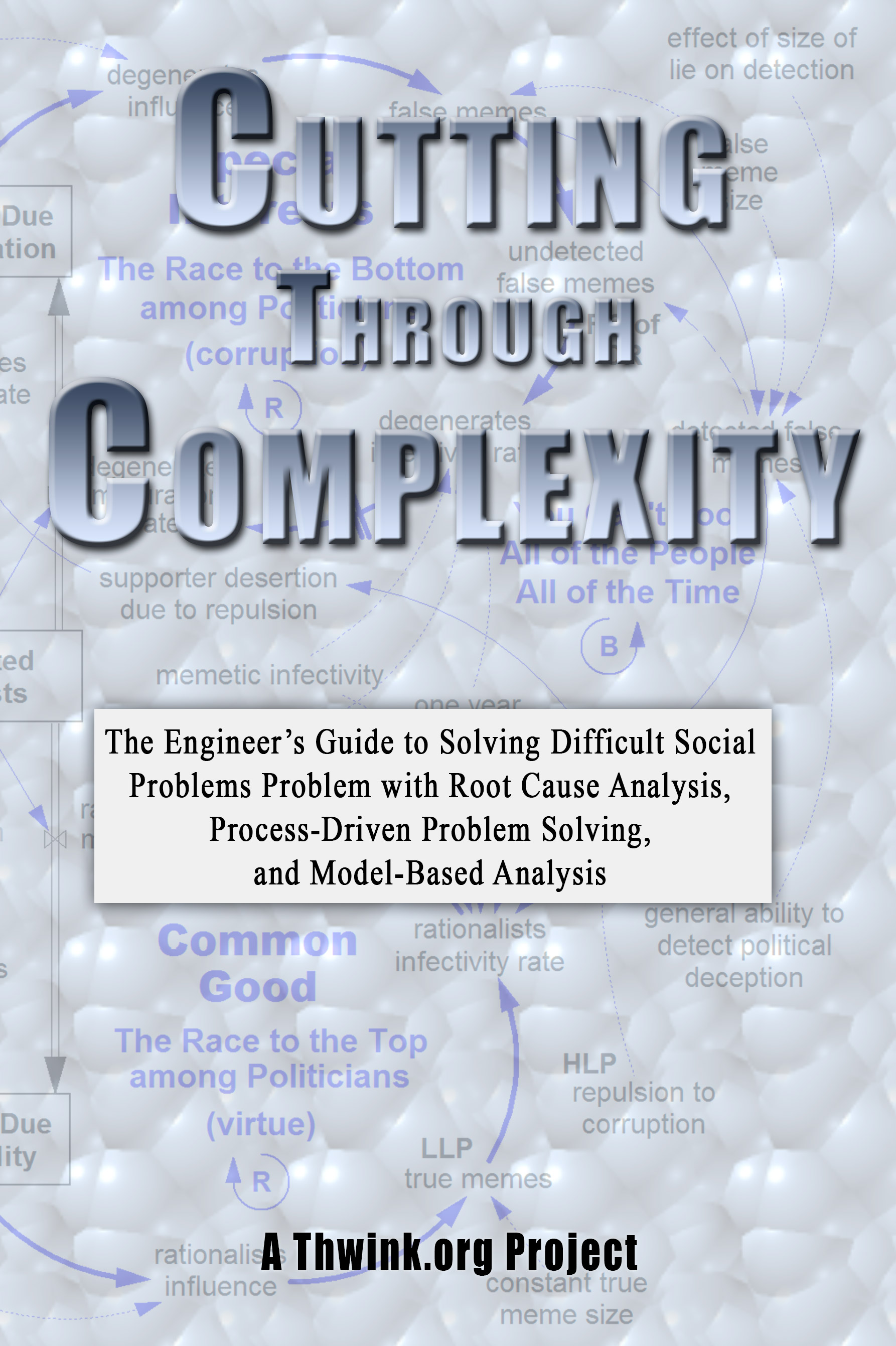 2. We're writing a new book. You can critique it as new chapters emerge. This would be tremendous assistance, because it's hard for the author to see how others will react. We need honest feedback on these questions: Is the book understandable? Is it persuasive? Is it engaging enough to keep reading? Is it too technical? The audience is influential environmentalists. Here's the book.
3. Help us improve the materials. Thwink.org is an educational reference site. It's loaded with a wide variety of materials on how to more productively go about solving the sustainability problem. These items can be improved. Some could be written better. Some that are needed are missing. When you see a way to improve something, contact us and let us know.
4. Share these ideas with others. Little progress is being made with current approaches to solving the sustainability problem. Thwink.org offers a way forward based on application of new tools, like root cause analysis and the System Improvement Process. Share these ideas with others. Sit down with influential people you know and show them what excites you. Explain WHY it can help us move forward. Or introduce us to someone you know and let us chat with them.
5. Innovative new ideas. Perhaps you have some insights about how the Thwink approach or materials could be improved in a whole new way. Or maybe just a small twist that could make a big difference.
Thanks. One small step at a time we can work together to help solve the most important problem in the world.
-

-
Analysis is the breaking down of a problem into smaller easier to solve problems. Exactly how this is done determines the strength of your analysis.
You will see powerful techniques used in this analysis that are missing from what mainstream environmentalism has tried. This explains why a different outcome can be expected.
The key techniques are proper subproblem decomposition and root cause analysis.
The analysis was performed over a seven year period from 2003 to 2010. The results are summarized in the Summary of Analysis Results, the top of which is shown below:
Click on the table for the full table and a high level discussion of analysis results.
This is the solution causal chain present in all problems. Popular approaches to solving the sustainability problem see only what's obvious: the black arrows. This leads to using superficial solutions to push on low leverage points to resolve intermediate causes.
Popular solutions are superficial because they fail to see into the fundamental layer, where the complete causal chain runs to root causes. It's an easy trap to fall into because it intuitively seems that popular solutions like renewable energy and strong regulations should solve the sustainability problem. But they can't, because they don't resolve the root causes.
In the analytical approach, root cause analysis penetrates the fundamental layer to find the well hidden red arrow. Further analysis finds the blue arrow. Fundamental solution elements are then developed to create the green arrow which solves the problem. For more see Causal Chain in the glossary.
First the analysis divided the sustainability problem into four subproblems. Then each subproblem was individually analyzed. For an overview see The Four Subproblems of the Sustainability Problem.
This is no different from what the ancient Romans did. It’s a strategy of divide and conquer. Subproblems like these are several orders of magnitude easier to solve because you are no longer trying (in vain) to solve them simultaneously without realizing it. This strategy has changed millions of other problems from insolvable to solvable, so it should work here too.
For example, multiplying 222 times 222 in your head is for most of us impossible. But doing it on paper, decomposing the problem into nine cases of 2 times 2 and then adding up the results, changes the problem from insolvable to solvable.
Change resistance is the tendency for a system to resist change even when a surprisingly large amount of force is applied.
Overcoming change resistance is the crux of the problem, because if the system is resisting change then none of the other subproblems are solvable. Therefore this subproblem must be solved first. Until it is solved, effort to solve the other three subproblems is largely wasted effort.
The root cause of successful change resistance appears to be effective deception in the political powerplace. Too many voters and politicians are being deceived into thinking sustainability is a low priority and need not be solved now.
The high leverage point for resolving the root cause is to raise general ability to detect political deception. We need to inoculate people against deceptive false memes because once people are infected by falsehoods, it’s very hard to change their minds to see the truth.
Life form improper coupling occurs when two social life forms are not working together in harmony.
In the sustainability problem, large for-profit corporations are not cooperating smoothly with people. Instead, too many corporations are dominating political decision making to their own advantage, as shown by their strenuous opposition to solving the environmental sustainability problem.
The root cause appears to be mutually exclusive goals. The goal of the corporate life form is maximization of profits, while the goal of the human life form is optimization of quality of life, for those living and their descendents. These two goals cannot be both achieved in the same system. One side will win and the other side will lose. Guess which side is losing?
The high leverage point for resolving the root cause follows easily. If the root cause is corporations have the wrong goal, then the high leverage point is to reengineer the modern corporation to have the right goal.
Solution model drift occurs when a problem evolves and its solution model doesn’t keep up. The model “drifts” away from what’s needed to keep the problem solved.
The world’s solution model for solving important problems like sustainability, recurring wars, recurring recessions, excessive economic inequality, and institutional poverty has drifted so far it’s unable to solve the problem.
The root cause appears to be low quality of governmental political decisions. Various steps in the decision making process are not working properly, resulting in inability to proactively solve many difficult problems.
This indicates low decision making process maturity. The high leverage point for resolving the root cause is to raise the maturity of the political decision making process.
In the environmental proper coupling subproblem the world’s economic system is improperly coupled to the environment. Environmental impact from economic system growth has exceeded the capacity of the environment to recycle that impact.
This subproblem is what the world sees as the problem to solve. The analysis shows that to be a false assumption, however. The change resistance subproblem must be solved first.
The root cause appears to be high transaction costs for managing common property (like the air we breath). This means that presently there is no way to manage common property efficiently enough to do it sustainably.
The high leverage point for resolving the root cause is to allow new types of social agents (such as new types of corporations) to appear, in order to radically lower transaction costs.
-
There must be a reason popular solutions are not working.
Given the principle that all causal problems arise from their root causes, the reason popular solutions are not working (after over 40 years of millions of people trying) is popular solutions do not resolve root causes.
This is Thwink.org’s most fundamental insight.
Using the results of the analysis as input, 12 solutions elements were developed. Each resolves a specific root cause and thus solves one of the four subproblems, as shown below:
Click on the table for a high level discussion of the solution elements and to learn how you can hit the bullseye.
The solutions you are about to see differ radically from popular solutions, because each resolves a specific root cause for a single subproblem. The right subproblems were found earlier in the analysis step, which decomposed the one big Gordian Knot of a problem into The Four Subproblems of the Sustainability Problem.
Everything changes with a root cause resolution approach. You are no longer firing away at a target you can’t see. Once the analysis builds a model of the problem and finds the root causes and their high leverage points, solutions are developed to push on the leverage points.
Because each solution is aimed at resolving a specific known root cause, you can't miss. You hit the bullseye every time. It's like shooting at a target ten feet away. The bullseye is the root cause. That's why Root Cause Analysis is so fantastically powerful.
The high leverage point for overcoming change resistance is to raise general ability to detect political deception. We have to somehow make people truth literate so they can’t be fooled so easily by deceptive politicians.
This will not be easy. Overcoming change resistance is the crux of the problem and must be solved first, so it takes nine solution elements to solve this subproblem. The first is the key to it all.
In this subproblem the analysis found that two social life forms, large for-profit corporations and people, have conflicting goals. The high leverage point is correctness of goals for artificial life forms. Since the one causing the problem right now is Corporatis profitis, this means we have to reengineer the modern corporation to have the right goal.
Corporations were never designed in a comprehensive manner to serve the people. They evolved. What we have today can be called Corporation 1.0. It serves itself. What we need instead is Corporation 2.0. This life form is designed to serve people rather than itself. Its new role will be that of a trusted servant whose goal is providing the goods and services needed to optimize quality of life for people in a sustainable manner.
Solution element: Corporation 2.0
What’s drifted too far is the decision making model that governments use to decide what to do. It’s incapable of solving the sustainability problem.
The high leverage point is to greatly improve the maturity of the political decision making process. Like Corporation 1.0, the process was never designed. It evolved. It’s thus not quite what we want.
The solution works like this: Imagine what it would be like if politicians were rated on the quality of their decisions. They would start competing to see who could improve quality of life and the common good the most. That would lead to the most pleasant Race to the Top the world has ever seen.
Solution element: Politician Decision Ratings
Presently the world’s economic system is improperly coupled to the environment. The high leverage point is allow new types of social agents to appear to radically reduce the cost of managing the sustainability problem.
This can be done with non-profit stewardship corporations. Each steward would have the goal of sustainably managing some portion of the sustainability problem. Like the way corporations charge prices for their goods and services, stewards would charge fees for ecosystem service use. The income goes to solving the problem.
Corporations gave us the Industrial Revolution. That revolution is incomplete until stewards give us the Sustainability Revolution.
Solution element: Common Property Rights
-
This presents our research results, including SIP, analysis of the environmental sustainability problem, and twelve sample solution elements.
This analyzes the world’s standard political system and explains why it’s operating for the benefit of special interests instead of the common good. Several sample solutions are presented to help get you thwinking.
-
The Democracy in Crisis Film Series
Introduction to the WorldChange Model, 27 min
Adding Change Resistance to IGMs, 29 min
Part 1. Introduction to Common Property Rights, 15 min
Part 2. The 7 Components of Common Property Rights, 23 min
Truth or Deception, 10 min
The Progressive Paradox Film, 123 min
Introduction to Analytical Activism, 48 min
-
One way to get started is The Common Property Rights Project.
This can be done by switching to Root Cause Analysis, which will lead to Environmentalism 2.0.


