A Brief Introduction to the PPKB
Basic Terms
A text is anything someone has written or said, in a speech, article, video, conversation, etc. The term "text" signifies the discourse has been captured as text and is ready to be analyzed.
The standard definion of an argument is one or more premises supporting a conclusion. The PPKB, in order to add rigor, takes this a little further. A PPKB argument consists of a conclusion, at least one factual, and at least one rule of inference. A factual is a fact, premise, intermediate conclusion, or main conclusion. A rule states how a conclusion follows from its factuals. A PPKB argument may be simple, with only one conclusion, or it may be complex, with multiple premises, intermediate conclusions, and a final main conclusion. Most real world arguments are complex.
In the PPKB, texts are analyzed by identifying their arguments and analyzing each argument. Each argument makes a claim, which is the argument's main conclusion. This receives an automatically calculated confidence level of 0% to 100%, which measures how much confidence the analyst has that the claim is true. The weighted total of the argument confidence levels become the confidence level for the text.
A weight is the relative importance given to each argument in a text. This is necessary since some arguments matter very little, while others are of central importance. For example, in a television ad the argument "I'm Obama, and I approve this message" implies this is a legitimate ad. It's of low importance so it receives a low weight. Weights are also used in argument elements, as explained below.
A Simple Classic Argument
Here's the standard classic argument used to illustrate what an argument is:
1. All men are mortal.
2. Socrates is a man.
3. Therefore Socrates is mortal.
Elements 1 and 2 are premises. Element 3 is the conclusion. The conclusion logically follows from the premises by application of a rule of inference called Modus ponens: "If P, then Q. P. Therefore Q." Here's how this rule applies: Element 1, "All men are mortal," is the same as "If the object is a man then it is mortal." This may be abstracted as "If P, then Q." Element 2, "Socrates is a man," may be abstracted as "P." Element 3, "Therefore Socrates is mortal," follows logically.
Take the time to examine how this rule of inference applies to elements 1, 2, and 3. If you can clearly grasp how this works and start thinking this way when you examine arguments, then you will find the PPKB fairly easy to use. Don't worry if you have to read this section several times, because we normally don't think this way. But if we want to be able to correctly and efficiently learn how to analyze arguements, we must learn how to think this way. There is no alternative.
Arguments quickly become so complex that the human mind becomes unable to understand how they work and how sound they really are. This forces the mind to resort to intuition, which is unreliable. To reduce this tendency the PPKB automatically generates a diagram (or map) of the structure of each argument. The diagram for the above argument looks like this:
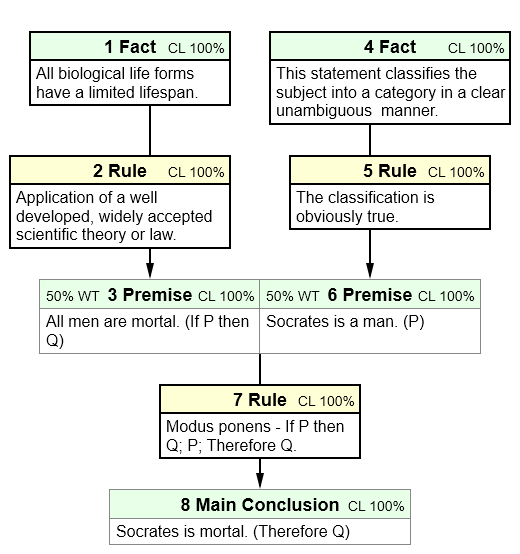
Boxes 3, 6, and 8 correspond to elements 1, 2, and 3, in the original argument above. Box 7 is the Modus ponens rule of inference. Boxes 1, 2, 4, and 5 have been added to make the analysis complete rather than partial. How do we know "All men are mortal"? How do we know "Socrates is a man"? In rigorous argument analysis we must take these premises and go back to the real world facts they are based on. Boxes 1, 2, 4, and 5 show how this may be done. It's extra work. But it takes your analysis from fluff to concrete, from unreliable to reliable.
Note how much information the diagram contains. Factuals (facts, premises, or conclusions) are green, rules are yellow. Each element has a confidence level (CL). If more than one factual or more than one rule is used to reach a conclusion, they have weights. (For simplicity these are 50% for the two premises.) The diagram is designed to be read rapidly, which you will frequently do as you analyze arguments. Compare the PPKB argument diagram to other argument maps.
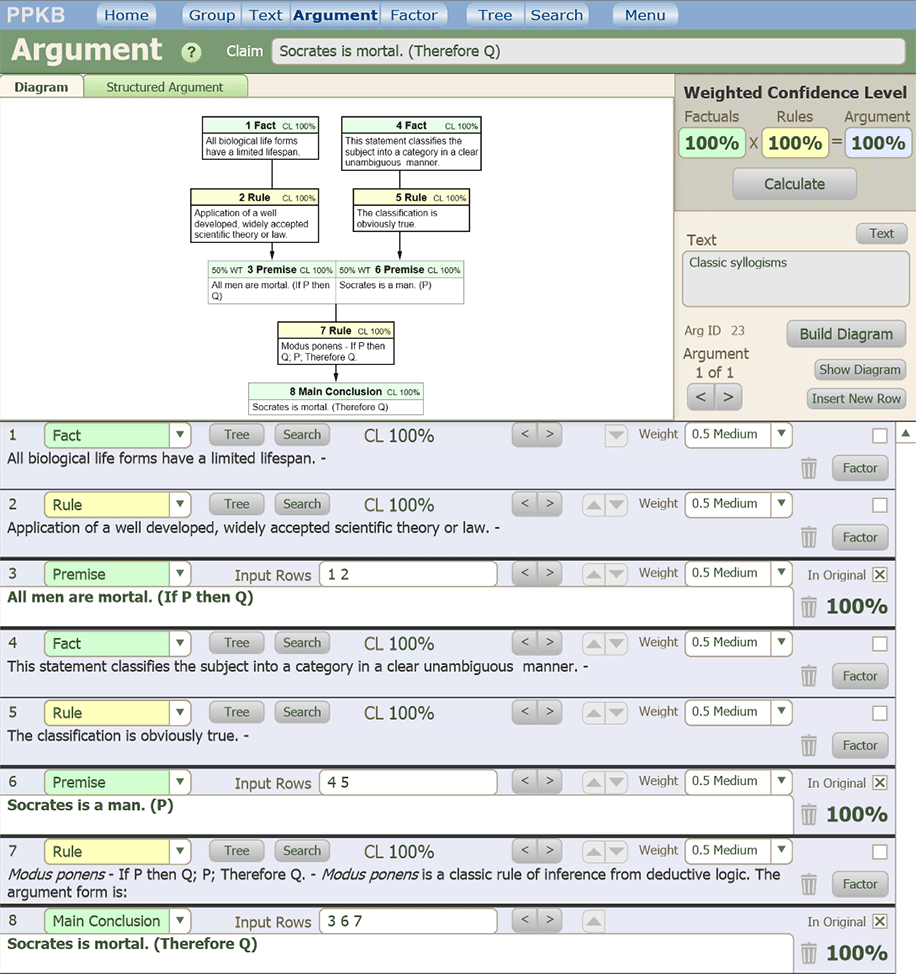
Finally, here's how the fully analyzed argument looks:
How to Analyze a Text
Suppose you have a text. Here's how to analyze it using the PPKB:
- TEXT GROUP - Add a new Text Group if necessary. A Text Group contains a group of texts, such as the TV ads for a particular campaign. Each ad is a text. Text Groups are useful for comparing the analysis results of one group of texts to other groups, as well as analyzing the results of the texts in a group.
- TEXT - Add a new Text to a Text Group.
- ORIGINAL TEXT TAB - In the Text form, click the Original Text tab. Copy and paste the text into the one large textbox. Let's use this actual text from a U.S. TV ad as an example:
- MARKED TEXT TAB - Click the Marked Text tab. Copy and paste the same text into the one large text box. Then study it closely. Understand what the text is trying to say and how it makes its case. Identify where the argument elements are using marks like "(Premise)" and "(Conclusion)." There is usually more than one argument unless the text is very short. For multiple arguments use marks like (1 Conclusion) and (2 Conclusion). Start by identifying the conclusions first. For example:
- TRANSLATED TEXT TAB - Copy the marked text. Click on the Translated Text tab. Paste. Rearrange the text into one paragraph per element. Remove extraneous text. Then translate each element into a non-emotive (non-emotional) statement that is a complete logical sentence. This step will be hard for some texts due to the high emotive content, but it must be done. Otherwise the emotion will obscure the logic and the argument will be impossible to analyze objectively.
- STRUCTURED ARGUMENTS TAB - Copy the translated text. Click on the Structured Arguments tab. Paste. Now comes the hardest part of the analysis. Rearrange the text so that each argument is listed separately. Add and clarify as necessary. Structure each argument by having one paragraph for each element. Each argument should have one main conclusion at the bottom.
- ADD ARGUMENT ELEMENTS - Now for the fun part, where the magic happens. Add one argument row to the text for each argument in Structured Arguments. Copy the text for each argument and paste it into the row.
- For each argument row, click on Show. This takes you to the Argument form. Add one row for each element in your structured argument. Take your time, because there will be considerable discovery and evolution until you have analyzed many arguments. Add facts and persuaders to the database as necessary, though this should be minimized to avoid clutter. Give each element except the main conclusion its correct weight if necessary.
- CALCULATE - When all elements are entered click Calculate. This will validate your argument rows and give helpful feedback if errors are encountered. If an error is found, fix the problem and click Calculate again.
- REVIEW - When all errors are fixed, calculation results will appear. Check them closely. Do they make sense? Do they reveal any bias? Could you confidently stand behind these results and justify every decision you made in each argument row? Have you reused as many facts and persuaders as possible, rather than adding new ones?
- If the answer to all these questions is yes, congratulations. You have made a vital contribution to the Political Persuasion Knowledge Base.
Obama: Those ads, taking my words about small business out of context, they’re flat out wrong. Of course Americans build their own businesses. Every day, hardworking people sacrifice to meet a payroll, create jobs, and make our economy run. And what I said was that we need to stand behind them, as America always has, by investing in education and training, roads and bridges, research and technology. I’m Barack Obama, and I approve this message because I believe we’re all in this together.
Obama: Those ads, taking my words about small business out of context, (1 Conclusion) they’re flat out wrong. Of course Americans build their own businesses. Every day, hardworking people sacrifice to meet a payroll, create jobs, and make our economy run. And what I said was that we need to stand behind them, as America always has, by investing in education and training, roads and bridges, research and technology. (2 Conclusion) I’m Barack Obama, and I approve this message because I believe (3 Conclusion) we’re all in this together.
This is a tricky text to analyze. An argument consists of one or more premises supporting a conclusion. In this text the arguments overlap and are scattered about. Their components are not all present but are implied. This makes political text analysis challenging. But if you can clearly identify the conclusions, then you can make a reasonable analysis.
The above box shows three conclusions identified. The next step is to identify the premises:
Obama: (1 Premise) Those ads, taking my words about small business out of context, (1 Conclusion) they’re flat out wrong. (1 Premise) Of course Americans build their own businesses. (1 Premise) Every day, hardworking people sacrifice to meet a payroll, create jobs, and make our economy run. And what I said was that (3 Premise) we need to stand behind them, as America always has, by investing in education and training, roads and bridges, research and technology. (2 Conclusion, premises implied) I’m Barack Obama, and I approve this message because I believe (3 Conclusion) we’re all in this together.
The premises and conclusions are identified. It's still hard to understand, so let's translate it into something more understandable.
(Show example here)
(Show example here)