All Packages Class Hierarchy This Package Previous Next Index
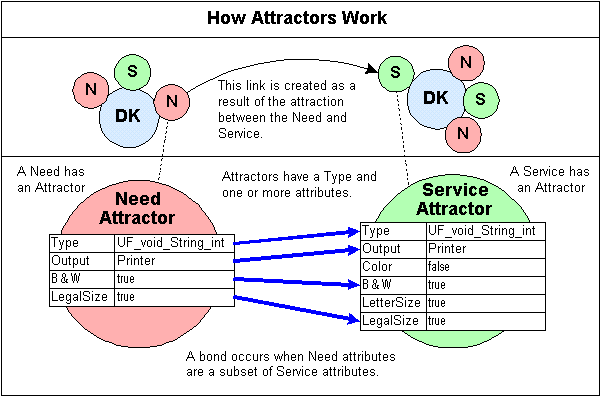
Attractors describe a desired bond between a client and a host. The host has the service desired. The client uses the service by casting the service to the attractor type and then calling methods. Here's what the abstraction looks like:
We hope most attractor types will be Unifaces, but we allow anything, classes or interfaces, single or multiple methods, for flexibility. After all, one size rarely fits all. Note that a Uniface can pass a Datatron as an argument.
A "Uniface" is a reusable interface with a single method devoid of semantic meaning. For example:
     public interface UF_double_double_int {
         public double get(double arg1, int arg2);
     }
Unifaces and attractors work together to offer these benefits for reusable part collaboration:
1. One line of code to use a uniface versus an average of 4 lines with Messages.Attractors are used to satisfy needs automatically by "matching" a ServiceClient's ServiceNeeds with available ServiceHost ServiceItems. The matching is done by comparing ServiceItem and ServiceNeed attractors. The types must be equal for a match.2. Unifaces are much faster than Messages. They approach or equal the speed of normal method calls.
3. A clean Anonymous Collaboration mechanism.
4. Easy automatic hookup in many or most cases.
5. Easy support of hierarchical Service Architecture.
6. Precise, full publishing of a part's input and output.
7. Strong typing.
8. Very fine grained reuse, on a per method level rather than per class.
A probable future feature is to allow attractors to be made immutable after configuration. This would allow safer use and encourage the sharing of attractors between different part instances. This could be done by adding the methods void makeImmutable() and boolean isImmutable(). In an implemenation all mutator methods would call an internal method such as checkImmutable() that would throw an IllegalStateException if immutable. Since this is an optimization feature we are postponing it. After all, as Dijkstra said, "Premature optimization is the root of all evil". :-)
We may add convenience methods to allow easy use of the primitive values like boolean, int, etc, for attributes. All this will occur as needed.

 addType(String)
containsAttribute(Object,
Object)
containsKey(Object)
containsType(String)
enumerateKeys()
enumerateTypes()
equals(Object)
getAttributeCount()
getTypeCount()
getValue(Object)
hashCode()
isAttributeSubset(Attractor)
isTypeSubset(Attractor)
putAttribute(Object,
Object)
toString()
addType(String)
containsAttribute(Object,
Object)
containsKey(Object)
containsType(String)
enumerateKeys()
enumerateTypes()
equals(Object)
getAttributeCount()
getTypeCount()
getValue(Object)
hashCode()
isAttributeSubset(Attractor)
isTypeSubset(Attractor)
putAttribute(Object,
Object)
toString()

 addType
public abstract void addType(String type)
If Unifaces are used then a service has only one type, and a need for that service also has only one type. However we offer the flexibility of multiple types to avoid overly contraining the designer.
A service has one or more types. This allows a service to evolve and still have backwards compatability with prior needs. For example if a service implements a new interface that extends the old interface, it adds both interfaces as types. A need for the old type will be honored, as well as allowing more currently written needs to use the new type.
A need has one or more types, though usually just one. If it has more than one then upon receiving the service it casts it to the most opportune type.
containsType
public abstract boolean containsType(String type)
getTypeCount
public abstract int getTypeCount()
enumerateTypes
public abstract Enumeration enumerateTypes()
putAttribute
 public abstract Object putAttribute(Object key,
                                     Object value)
getValue
public abstract Object getValue(Object key)
enumerateKeys
public abstract Enumeration enumerateKeys()
containsKey
public abstract boolean containsKey(Object key)
containsAttribute
 public abstract boolean containsAttribute(Object key,
                                           Object value)
getAttributeCount
public abstract int getAttributeCount()
isTypeSubset
public abstract boolean isTypeSubset(Attractor attractor)
isAttributeSubset
public abstract boolean isAttributeSubset(Attractor attractor)
toString
public abstract String toString()
equals
public abstract boolean equals(Object object)
hashCode
public abstract int hashCode()
All Packages Class Hierarchy This Package Previous Next Index